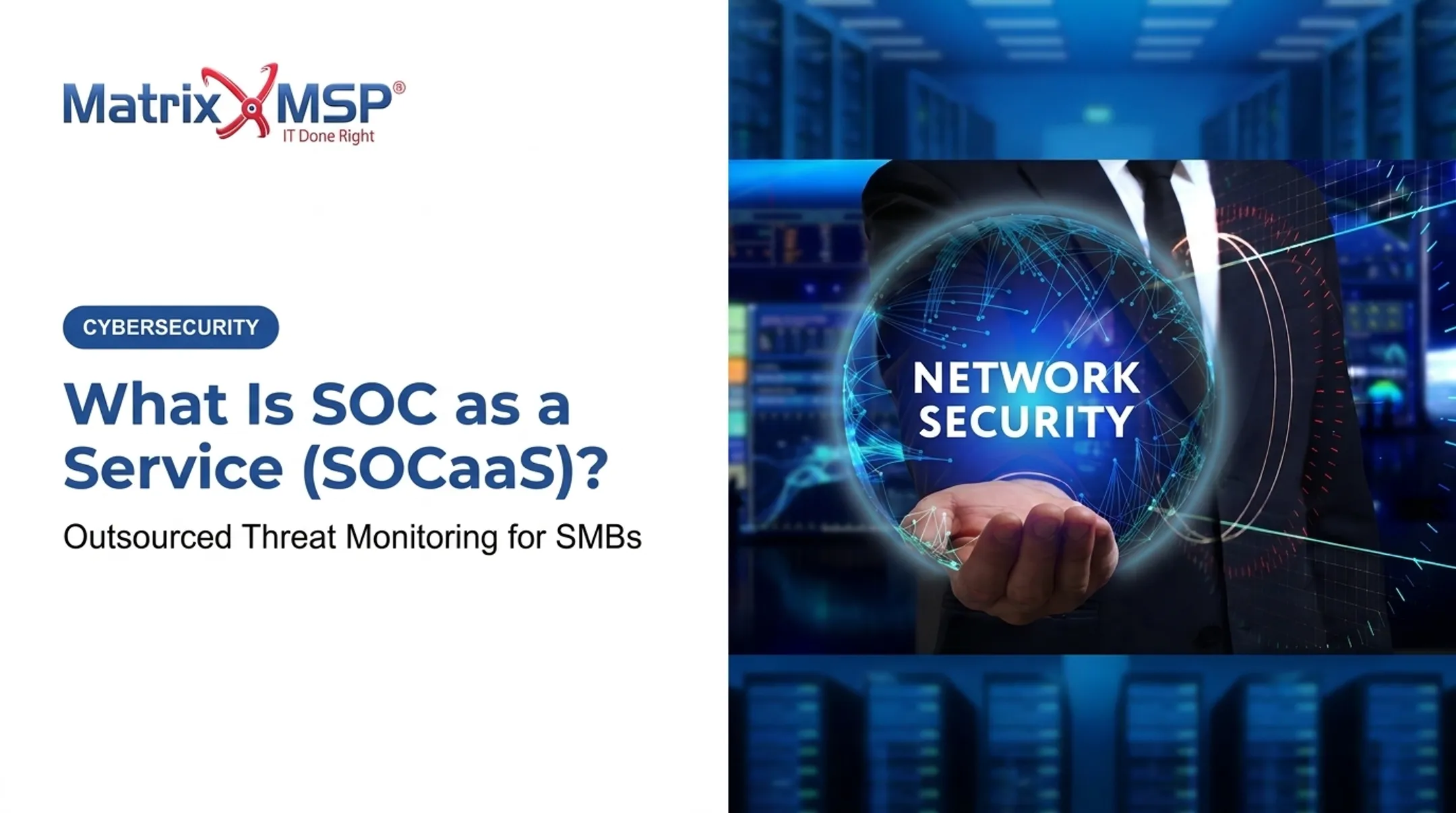
Building an in-house security operations center is expensive and slow. Hiring, training, and retaining skilled analysts takes months many businesses don't have. That's where Security as a Service (SECaaS) comes in: a cloud-based, subscription model that lets you outsource cybersecurity functions instead of buying and maintaining your own infrastructure.
This article breaks down what SECaaS actually means, how it works, its real benefits and risks, and what to look for in a provider like Matrix MSP.
Key Takeaways
- SECaaS delivers threat monitoring, identity management, data protection, and web security via subscription—not on-premises hardware
- Cuts upfront capital costs while giving you security experts and constantly updated tools
- Evaluate providers on service breadth, response times, compliance expertise, and scalability
- Regulated SMBs—nonprofits, healthcare, and financial firms—gain the most where compliance burden is highest
What Is Security as a Service (SECaaS)?
SECaaS is a cloud-delivered model where a third-party provider manages your cybersecurity functions on a subscription basis. No racks of appliances. No dedicated server room.
Fortinet describes it as outsourcing your cybersecurity to a provider who runs the infrastructure remotely—useful when in-house teams are already stretched thin.
The term borrows from the broader "as-a-Service" cloud family (SaaS, PaaS, IaaS) and applies that same subscription logic to security. Below: how SECaaS works, how it differs from an MSSP, and the related terms you'll see in vendor conversations.
SECaaS vs. MSSP: What's the Difference?
People use these terms interchangeably, but they're not identical:
- SECaaS describes how security is delivered: cloud-based, subscription-driven
- MSSP (Managed Security Service Provider) describes who operates it: a company actively monitoring and managing your security systems
An MSSP is one delivery model under the broader SECaaS umbrella.
Adoption is climbing because of three pressures: rising cloud usage, more DevOps environments, and a persistent shortage of in-house security talent.
IBM found that more than half of breached organizations had severe staffing shortages, a jump of 26.2% from the prior year. Gartner projects the broader security services market will hit $118 billion by 2029, growing at nearly 9% annually.
Common SECaaS Terms Businesses Should Know
Related labels often overlap. In plain terms:
- Cybersecurity as a service — recurring delivery of protective controls for your systems and data
- Network security as a service — cloud-delivered protection for your network traffic and infrastructure
- Cloud security as a service — security controls for cloud-hosted workloads, shared between you and your provider
- Web security as a service — protecting websites, apps, and users from malware, DDoS attacks, and unauthorized access
How SECaaS Works: Core Components & Services
Providers host the tools and infrastructure remotely, then deliver protection through dashboards, APIs, and cloud consoles you can access anytime. Most SECaaS platforms combine the components below into one managed stack.

Identity and Access Management (IAM)
IAM controls who gets into your systems and what they can do once inside. Okta describes IAM as covering authentication, authorization, and access control for every user and resource. In practice, that means:
- Multi-factor authentication (MFA) requiring more than a password
- Single sign-on (SSO) so employees use one credential across tools
- Conditional access rules based on device, location, or risk level
Data Loss Prevention and Encryption
DLP tools scan for sensitive data patterns, like Social Security numbers or credit card data, and can block, log, or quarantine matches automatically. Encryption protects that same data whether it's sitting on a server or moving between systems.
Network and Web Security
This layer typically includes:
- Firewalls and intrusion detection/prevention systems
- Web Application Firewalls (WAFs) that inspect HTTP traffic
- Edge filtering that blocks exploits before they reach your app
A WAF stops malicious requests—such as SQL injection and cross-site scripting—before they hit your application. Cloudflare's WAF, for example, filters requests at the edge so attacks never touch your web app.
Continuous Monitoring and Compliance Support
SECaaS providers run these as always-on layers:
- 24/7 monitoring and threat intelligence feeds
- Incident response when something looks wrong
- Compliance reporting for HIPAA, PCI DSS, and SOC 2
You get audit-ready documentation on an ongoing basis instead of a last-minute scramble before an assessment.
Matrix MSP, for example, delivers SECaaS-style coverage by bundling 24/7 monitoring, SIEM as a service, managed firewalls and VPNs, email and web security, and endpoint protection—with support for PCI, HIPAA, SOX, and FFIEC requirements.

Benefits of SECaaS for Small and Mid-Sized Businesses
The case for SECaaS goes beyond convenience:
- Lower upfront costs: no hardware to buy; subscription pricing that scales with you
- Specialized expertise: security talent without hiring, training, or retaining a full in-house team
- Faster scalability: add protections as your business grows or changes direction
- Continuous protection: 24/7 monitoring and quicker incident response
- Simplified compliance: practical help for healthcare, finance, and law firms juggling overlapping rules
Partnering with a vendor-neutral managed IT provider like Matrix MSP means you are not stitching together separate vendor relationships for every tool. Security, cloud, compliance, and day-to-day IT support sit under one roof, so when an incident hits you have a single point of contact.

SECaaS Risks and Challenges to Consider
Outsourcing security isn't risk-free. Three things worth weighing:
- Loss of direct control: you're trusting a third party with decisions that used to be yours
- Shared technology risk: a breach at the provider level can ripple across multiple clients simultaneously
- Data leakage exposure: if the provider itself gets attacked, your data is part of what's at stake
The 2021 Kaseya VSA incident is the textbook example. CISA documented how attackers exploited a vulnerability in Kaseya's platform to hit multiple MSPs and their downstream customers at once. It's a real illustration of concentration risk when one provider manages security for many businesses.
These risks are manageable when you ask the right questions before you sign a contract.
How to Choose the Right SECaaS Provider
Not all providers cover the same ground. Before committing, evaluate:
- Breadth of services — threat detection, IAM, DLP, compliance support, and network/web security, not just a single point solution
- Certifications and experience — has the provider worked with businesses your size, in your industry?
- Availability and response commitments — is monitoring truly 24/7, and what's the escalation process?
- Scalability and integration — will this fit your existing IT and cloud stack as you grow?

Those criteria point to a partner that covers security alongside broader IT—not a single-point tool vendor.
Matrix MSP is a single-source, vendor-neutral managed IT and security partner for SMBs and nonprofits. Its offering includes 24/7 monitoring and support, guaranteed data protection through layered backup and recovery, and customizable flat-rate plans.
The team works with providers such as Microsoft, Dell, VMware, and Symantec. Matrix MSP serves Washington DC, Maryland, and Virginia directly and extends support nationwide across the US and Canada through partnerships.
Frequently Asked Questions
What is security as a service?
SECaaS is a cloud-based subscription model for outsourcing cybersecurity functions like threat monitoring, identity and access management, and data loss prevention. It replaces the need for on-premises security hardware.
What is a cybersecurity service provider?
A cybersecurity service provider delivers outsourced security solutions—monitoring, threat detection, and incident response—for client businesses. Some specialize as MSSPs; others bundle security into broader managed IT support.
What are the security considerations for platform as a service?
Key PaaS concerns include shared responsibility, data isolation between tenants, API security, and access control. The provider secures the infrastructure; you secure your applications. Per NIST, you control deployed apps—not the underlying servers or network.
What is web security in simple words?
Web security protects your websites, apps, and users from threats like malware, DDoS attacks, and unauthorized access attempts. It covers everything from your login page to the APIs powering your app.
What is an example of a WAF?
Cloudflare's WAF inspects incoming HTTP/S traffic at the network edge and blocks malicious requests, including SQL injection and cross-site scripting attempts, before they reach your web application.