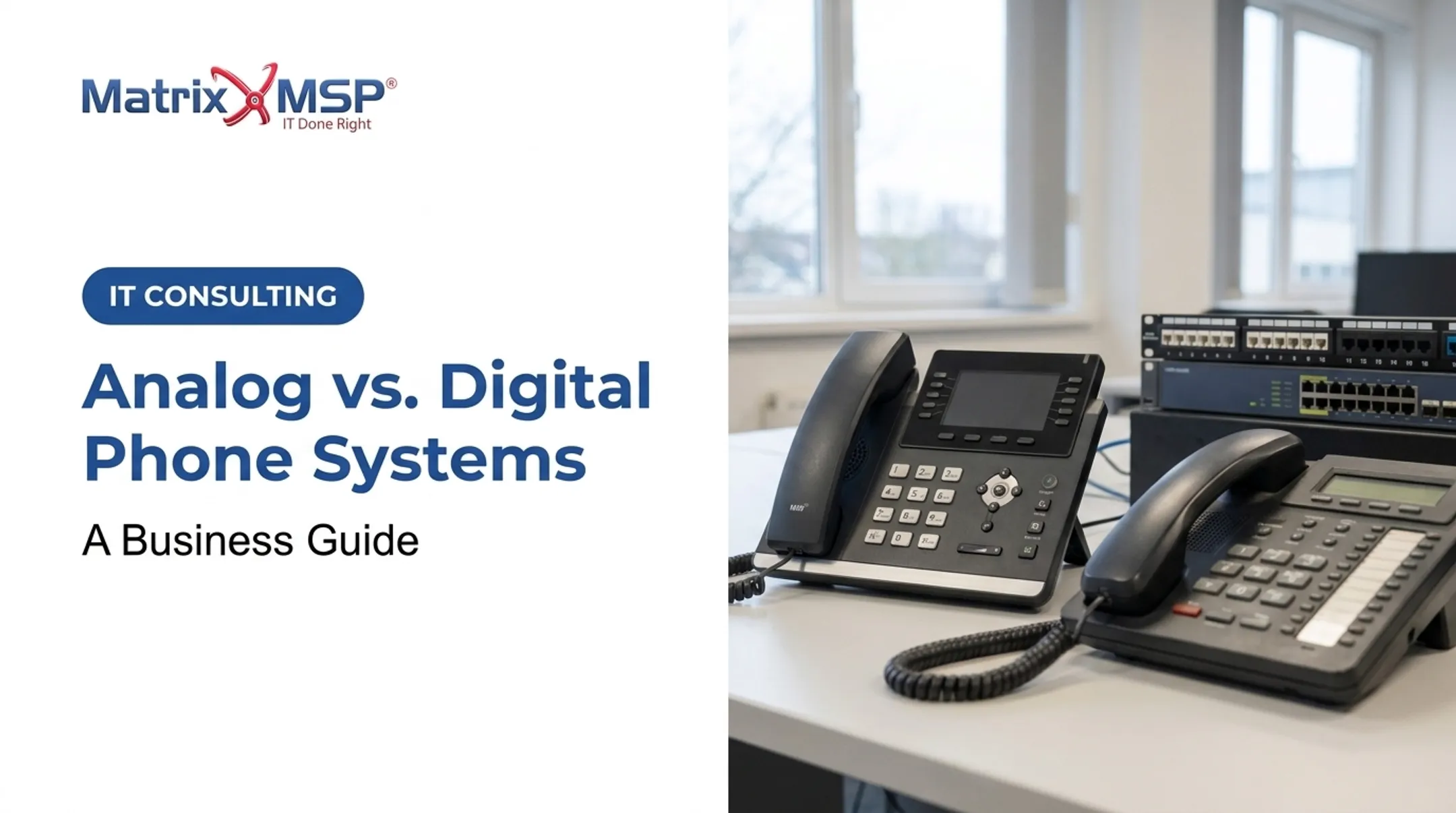
This decision affects your budget, your ability to grow, and your reliability during outages, especially as carriers phase out copper infrastructure across the country. This article breaks down how analog and VoIP compare, where each one fits, and how to figure out which one makes sense for your business.
TL;DR
- Analog (POTS) runs on copper wires and dedicated landlines: simple setup, but limited features and scale
- VoIP routes calls over the internet, offering flexibility, advanced features, and lower long-term costs
- Base your choice on cost, reliability, feature needs, and growth plans
- Multi-location or remote-friendly businesses benefit more from VoIP
- Managed providers like Matrix MSP can help you evaluate options and handle the transition
Analog vs. VoIP: Quick Comparison
Cost
Analog comes with higher line rental fees, per-line charges, and steep long-distance or international rates. VoIP typically runs on flat-rate monthly plans with lower long-distance costs, since calls travel over the internet instead of dedicated copper lines.
Technology and Infrastructure
- Analog: Copper wires, dedicated landline, RJ-11 connection
- VoIP: Internet-based, cloud platform, RJ-45/Ethernet connection
Scalability
Adding an analog line means new wiring and hardware, often with a technician visit. VoIP scales through software: add or remove users in minutes, no physical installation required.
Features
Analog offers the basics: hold, mute, and redial. VoIP platforms typically include:
- Auto attendant
- Voicemail-to-email
- Video conferencing
- CRM integration
- Call reporting and analytics

Mobility and Flexibility
Analog phones are tied to a desk and a physical location. VoIP lets employees make and receive calls from anywhere using mobile apps or softphones, which is useful for remote and hybrid teams.
Reliability and Future Outlook
Analog networks rely on proven, stable technology, but major carriers are actively retiring copper infrastructure. The FCC's technology transition framework confirms providers are retiring aging copper voice networks in areas where modern replacements exist, though this happens region by region rather than on one national deadline. VoIP depends on your internet connection, but supports failover options like mobile call forwarding. RingCentral reports a 99.999% uptime SLA for its MVP product across 20 consecutive quarters (less than 78 seconds of downtime per quarter). That figure is one provider's guarantee, not a universal VoIP standard, but it shows what a solid setup can deliver.
What Is an Analog Phone System?
Analog phone service, often called POTS (Plain Old Telephone Service), converts voice into electrical signals sent over copper wires. It's the same basic technology that has powered business landlines and fax machines for decades.
Core benefits:
- Simple to operate, no learning curve
- No internet dependency
- Compatible with familiar legacy equipment (fax machines, alarm systems, elevator phones)
Use Cases of Analog
Analog still makes sense for small, single-location businesses with minimal calling needs, dedicated fax lines, or locations where internet service is unreliable.
That said, the long-term picture is shifting. AT&T's own small business support documentation confirms that traditional copper wire service is being replaced with fiber optic technology.
There's no single nationwide shutoff date, but carriers are notifying customers area by area as copper networks get retired. If your business still runs on analog, check your carrier's local transition notices before you're forced into a rushed switch.

What Is a VoIP Phone System?
VoIP (Voice over Internet Protocol) is a cloud-based system that routes calls over the internet rather than copper wires. It matches how many businesses already work: distributed teams, multiple locations, and tools that need to connect.
Core benefits:
- Lower monthly costs and reduced long-distance fees
- Scalability without new wiring
- Feature sets that support productivity, not just calling
VoIP comes in two main types: hosted/cloud VoIP, where a provider manages the infrastructure, and on-premise VoIP PBX, where a business runs its own server hardware. Most small and mid-sized businesses choose hosted VoIP to avoid managing server hardware in-house.
Use Cases of VoIP
VoIP fits remote and hybrid teams, multi-location businesses, and nonprofits that need flexible, budget-conscious communication tools. According to the FCC's June 2025 Voice Telephone Services report, businesses had 43.972 million interconnected VoIP connections compared to just 8.612 million switched-access lines—roughly 84% of measured wireline business voice connections in the US.
Matrix MSP offers hosted VoIP as part of its managed IT solutions for small and mid-sized businesses and nonprofits. The service includes:
- Auto attendant and voice-to-email
- Video conferencing and CRM integration
- Company directory, custom caller ID, and on-hold music
- Over 150 total phone-system features
- Remote access from the office, home, or on the road

Pricing runs on a flat monthly fee per extension, and businesses can add or remove extensions as staffing changes.
Analog vs. VoIP: Which Is Better for Your Business?
There's no single right answer. Weigh these factors:
- Budget — Compare total cost of ownership, not just line rental vs. a monthly plan
- Number of locations — More sites favor VoIP's centralized management
- Remote workforce — Analog stays on-premises; VoIP follows employees anywhere
- Internet reliability — VoIP call quality depends on your connection
- Growth plans — VoIP scales without new physical line installs Choose analog if you:
- Run a single location with light calling needs
- Face genuinely unreliable internet in your area
- Want the simplest setup with minimal change Choose VoIP if you:
- Need scalability and multi-site management
- Support remote or hybrid work
- Want richer features and lower long-term costs Some businesses use a hybrid approach with analog telephone adapters (ATAs). ATAs keep legacy devices—fax machines, alarm systems—working while the rest of the phones move to VoIP, so you avoid an all-or-nothing cutover.
Real-World Example: Making the Switch
Angleton Independent School District is a documented example of phased migration. It ran an aging analog Nortel system that lacked call transfer and voicemail, and per-line costs kept climbing. Instead of a full cutover, the district moved a new high school and three admin buildings to VoIP first and left other campuses on analog. The rollout later reached 900 handsets across 16 locations. Staff cited 4-digit dialing as the biggest operational win, along with dropping most POTS lines and lowering costs. The write-up doesn't share exact dollar or uptime figures, so treat it as directional—not a guaranteed result. The practical takeaway: phase the move, prove VoIP in a few sites, then expand. If you're weighing a similar switch, Matrix MSP can assess your setup and handle a hosted VoIP transition that fits how you work.

Conclusion
There's no universal winner between analog and VoIP. The right choice depends on your business size, number of locations, budget, and where you're headed in the next few years. That said, VoIP is increasingly becoming the standard for businesses that need flexibility and room to grow.
The practical outcomes matter most: lower costs, more mobility, and phone service that stays ready when carriers retire copper lines in your area. Matrix MSP helps businesses plan and run that move—full cutover or phased—so the switch stays secure and disruption stays low. Start by matching system capabilities to how your teams actually work, then choose the migration path that fits your timeline.
Frequently Asked Questions
Can you use an IP phone as a regular phone?
Yes. IP phones make and receive calls just like traditional handsets, but they require an internet connection and proper network configuration to work correctly.
Are IP phones still used?
Yes. IP phones remain the dominant choice for business communications, with VoIP connections vastly outnumbering traditional switched-access lines among US businesses today.
Is VoIP cheaper than analog phone lines?
Generally, yes. VoIP plans typically offer lower monthly costs and reduced long-distance fees compared to analog lines. Exact savings depend on call volume, locations, and features.
Can I keep my existing phone number when switching to VoIP?
In most cases, yes. Number porting lets you keep existing business numbers when you switch to VoIP. The FCC requires simple ports to be completed within one business day.
What happens to VoIP calls during an internet or power outage?
VoIP requires internet and power to function, but failover options like mobile call forwarding and rerouting can keep your business reachable. Backup power solutions add further protection against extended outages.
Is analog phone service being phased out in the US?
Major carriers are retiring copper and POTS infrastructure in favor of fiber and IP-based service, though this is happening region by region rather than on one national deadline. Check your carrier's local transition notices to see how it affects your business.