The right cybersecurity stack doesn't just block attacks. It protects uptime, keeps data intact, and helps you pass compliance audits without slowing your team down.
The numbers back up the urgency: the US average cost of a data breach hit $10.22 million in 2025, an all-time high, according to IBM's 2025 Cost of a Data Breach Report. For small and mid-sized businesses, ransomware showed up in 88% of breaches, far above the rate seen at larger enterprises.
Key Takeaways
- 2026 cybersecurity stacks cover endpoint protection, network security, SIEM, IAM, and managed services
- Effective protection is multi-layered and scalable, matched to budget and compliance needs
- Choose solutions by risk profile, existing stack, total cost, and compliance obligations
- A managed IT/security partner simplifies rollout and sustains 24/7 monitoring
Overview of Cyber Security Solutions for US Businesses
Cybersecurity solutions are the tools, platforms, and services that protect networks, endpoints, data, and user identities from attack. That covers everything from firewalls and antivirus software to full managed detection and response (MDR) programs.
US small and mid-sized businesses have become prime targets because they often lack dedicated security staff. That gap is fueling demand for managed cybersecurity services.
Kaseya's 2024 MSP Benchmark Survey found that 78% of managed service providers call cybersecurity a top client challenge, and 73% reported growing security revenue as a result.
Below, we break down the top solutions and providers serving US businesses across healthcare, finance, legal, and nonprofit sectors.
Top Cyber Security Solutions for Businesses in 2026
We selected these solutions based on:
- Comprehensive coverage and scalability
- Ease of integration and vendor support
- Value for SMBs and nonprofits with limited internal IT resources
Matrix MSP
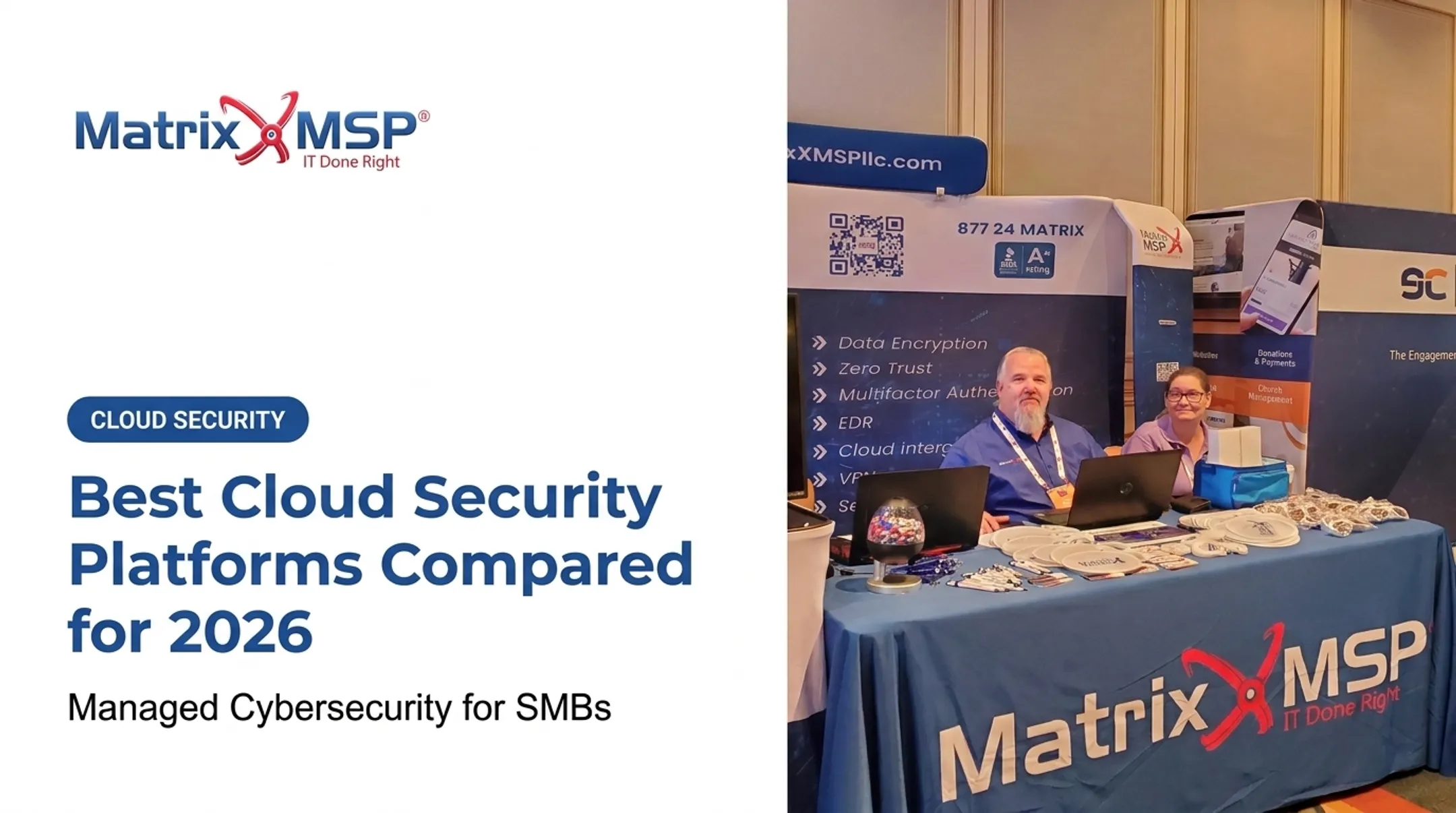
Matrix MSP has provided managed IT, network infrastructure, security, cloud, and compliance support to SMBs and nonprofits since 2007. The company operates as a single-source, vendor-neutral partner rather than pushing one product line.
What's included:
- 24/7/365 continuous monitoring of computers, servers, and network devices for suspicious activity
- Advanced endpoint protection, antivirus, and vulnerability scanning
- Managed firewall and VPN services, spam filters, and web filters
- Email and web security to reduce exposure to phishing and malicious content
- Data protection with onsite NAS backup and optional nightly offsite cloud backup
- Compliance support aligned with PCI, HIPAA, SOX, and FFIEC requirements
Onboarding follows four steps:
- Assess client needs
- Design and build protection
- Run a documented 356-point check to verify coverage
- Support the transition with around-the-clock help
| Category | Details |
|---|---|
| Key Features | Managed cybersecurity, network security, cloud security, compliance support, 24/7 monitoring |
| Best For | Small and mid-sized businesses, nonprofits, healthcare, finance, and legal organizations needing an outsourced security partner |
| Pricing Model | Customizable, flat-rate managed services plans available on one-, two-, or three-year terms |

SentinelOne
SentinelOne's Singularity platform uses AI-driven behavioral analysis to detect and respond to threats across endpoints, cloud workloads, and identities from one console.
Differentiators:
- ActiveEDR traces the full attack story, helping teams understand root cause without manual log digging
- One-click autonomous remediation rolls back affected systems
- Single console spans endpoint, cloud, and identity attack surfaces
| Category | Details |
|---|---|
| Key Features | ActiveEDR behavioral detection, autonomous response, cross-environment visibility |
| Best For | Mid-market to enterprise businesses needing real-time, autonomous protection |
| Pricing Model | Complete tier starts at $179.99/endpoint/year, Commercial at $229.99; Enterprise is quote-based (SentinelOne pricing) |
CrowdStrike Falcon
CrowdStrike Falcon is a cloud-native endpoint protection platform built on crowdsourced threat intelligence and graph analytics.
Differentiators:
- Threat Graph correlates endpoint, workload, and identity telemetry for historical threat hunting
- Detects fileless malware that traditional antivirus often misses
- Falcon Complete adds 24/7 human-led managed detection and response
| Category | Details |
|---|---|
| Key Features | Threat Graph analytics, fileless malware detection, optional managed MDR |
| Best For | Businesses wanting fast deployment with the option to add 24/7 detection and response |
| Pricing Model | Go tier from $7.99/month per device; Pro and Enterprise scale up to $19.99/month; Falcon Complete is quote-based (CrowdStrike pricing) |

Fortinet
Fortinet takes a network-centric approach, unifying firewalls, SD-WAN, and endpoint protection under its Security Fabric architecture.
Differentiators:
- AI-driven intrusion detection across the network perimeter
- High-performance hardware firewalls suited to multi-branch operations
- Unified policy management across the entire Security Fabric
| Category | Details |
|---|---|
| Key Features | Security Fabric integration, cloud sandboxing, next-gen firewalls |
| Best For | Businesses with complex network infrastructure or multiple branch locations |
| Pricing Model | Licensing combines hardware/VM appliances with security-service subscriptions; Fortinet notes Secure SD-WAN carries no separate bandwidth-based license |
IBM Security
IBM Security pairs QRadar SIEM with MaaS360 endpoint management, targeting organizations with heavier compliance and log-management needs.
Differentiators:
- QRadar SIEM centralizes visibility with over 700 prebuilt integrations
- X-Force threat intelligence feeds directly into detection workflows
- Automated incident triage reduces analyst workload
| Category | Details |
|---|---|
| Key Features | QRadar SIEM, MaaS360 endpoint management, automated triage |
| Best For | Larger organizations with complex compliance and log-management needs |
| Pricing Model | MaaS360 starts around $1.50–$9.54 per device/month depending on plan; QRadar licensing is quote-based (IBM MaaS360) |

How We Chose the Best Cyber Security Solutions
Picking a vendor on price alone is the most common mistake we see. The second most common: ignoring how a new tool will integrate with what's already running. Neither approach catches the gaps that lead to a breach.
We weighed each solution against factors tied directly to business outcomes:
- Breadth of protection layers — does it cover endpoints, network, identity, and cloud, or just one surface?
- Scalability — can it grow with the business without a painful re-platform?
- Vendor support and reputation — is there real human backup when something goes wrong at 2 a.m.?
- Compliance alignment — does it map to frameworks like HIPAA, PCI, or FFIEC where relevant?
- Ease of management — can existing staff run it, or does it require specialized hires?

A tool that scores well in a lab test but nobody on staff can actually operate isn't a win. That operational fit is what separates reduced downtime and lower breach risk from a shelfware purchase.
Conclusion
The right cybersecurity solution matches your risk profile, existing infrastructure, and where your business is headed over the next few years. Brand recognition alone is a weak reason to choose one stack over another.
Before committing, evaluate ongoing performance, scalability, and total cost of ownership, not just the sticker price on year one.
If you're not sure where your current setup stands, Matrix MSP offers cybersecurity assessments tailored to small and mid-sized businesses, nonprofits, and organizations across regulated industries. Contact Matrix MSP to talk through your options.
Frequently Asked Questions
How much do cyber security services typically cost?
Pricing varies by model: per-endpoint (roughly $8–$230/month depending on the tier), flat-rate managed services, or quote-based enterprise licensing. Cost depends on device count, modules, retention, and compliance scope.
What is the difference between SIEM and UTM?
SIEM centralizes logs across your environment and analyzes them for threats, functioning as an investigation and monitoring hub. UTM combines multiple security functions, like firewall, antivirus, and intrusion prevention, into a single network appliance.
What are the main cyber security solutions?
The core categories are endpoint security, network security, identity and access management (IAM), SIEM, and cloud security. Most businesses need a combination rather than a single tool.
What are the main types of cyber security?
The five main types are network, application, cloud, endpoint, and critical infrastructure security. Each type defends a different layer of your environment rather than a single product category.
What are the top cyber security tools?
Beyond the platforms covered above (SentinelOne, CrowdStrike, Fortinet, IBM Security), common tool categories include next-gen firewalls, EDR/XDR platforms, and multi-factor authentication systems.
What are effective ways to improve cyber security?
CISA recommends employee phishing training, strong passwords, multi-factor authentication, and regular software updates as baseline steps. Partnering with a managed security provider adds 24/7 monitoring that most businesses can't staff internally.