This matters most for small and mid-sized businesses, nonprofits, healthcare providers, financial firms, and other regulated organizations where data protection isn't optional. Many people confuse the term with vulnerability scans or penetration tests. They're related, but not the same thing.
This article breaks down the methodology, walks through the step-by-step process, covers what factors shape an assessment, and explains when businesses actually need one.
Key Takeaways
- Maps and ranks threats to IT systems, data, and networks so you know what to fix first
- Cuts breach exposure, supports HIPAA/PCI DSS compliance, and directs security spend to the highest-impact controls
- The process runs through asset identification, threat analysis, risk scoring, and mitigation planning
- Right-size scope by business size, industry rules, and a set reassessment cadence as threats change
What Is a Security Risk Assessment?
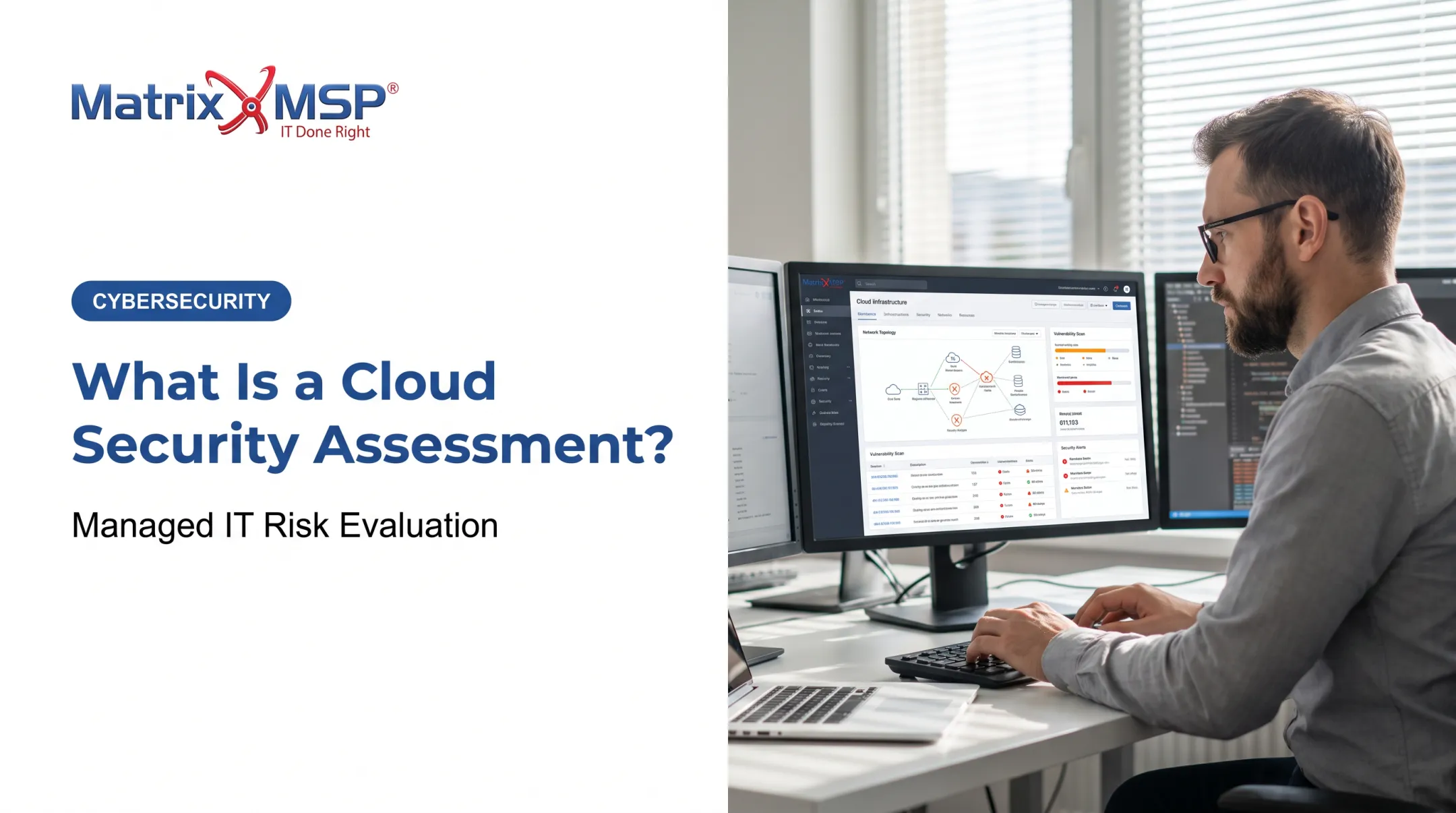
A security risk assessment is a systematic evaluation of your organization's assets, threats, vulnerabilities, and existing controls. The goal: determine overall risk exposure. NIST defines it as a systematic examination using disciplined processes, methods, and tools — not a one-off technical scan.
The output is a prioritized list of risks paired with recommended remediation actions that strengthen your security posture.
How it differs from related terms:
| Activity | What It Answers |
|---|---|
| Security risk assessment | Which threats and vulnerabilities matter most, given likelihood and impact? |
| Vulnerability assessment | What weaknesses exist in a specific system? |
| Penetration test | Can someone simulate an attack and break through defenses? |
A scan or pen test can feed evidence into a risk assessment. Neither one alone establishes business impact, ownership, or what to fix first.
Why Security Risk Assessments Are Used by Businesses
Small businesses assume attackers only target large enterprises. That assumption is expensive.
A 2023 Hiscox survey found 41% of US small businesses experienced at least one cyberattack. Median annual cost hit $8,300, and median attack frequency rose from 3 to 4 per year. That's not an enterprise problem anymore.
Why SMBs and nonprofits adopt assessments:
- Rising attack frequency targeting smaller, less-defended networks
- Third-party and vendor risk, with breach involvement doubling from 15% to 30% (Verizon's 2025 DBIR)
- Limited in-house security expertise to catch problems early
What happens without one:
- Undetected vulnerabilities sit exposed for months or years
- Regulatory non-compliance triggers fines and penalties
- Reactive incident response costs far more than prevention
Assessments serve dual purposes. They're regulatory-driven under HIPAA, PCI DSS, and GDPR, and sound operational practice even when no law requires them.
How the Security Risk Assessment Process Works (Methodology)
The process moves from scoping to asset inventory, threat identification, risk analysis, and mitigation planning. Typical inputs include:
- IT infrastructure details and data flow maps
- Existing security controls
- Applicable compliance requirements
Core analysis involves risk scoring: ranking each risk by likelihood and potential impact, using qualitative judgment or quantitative measurement. Frameworks like NIST SP 800-30 or ISO/IEC 27005 keep the work consistent rather than ad hoc.
The deliverable is a documented risk register and an actionable remediation roadmap, not a static findings list.

Step 1: Define Scope and Identify Assets
Catalog hardware, software, data, networks, and personnel. Classify each asset by business criticality so a customer database ranks above a spare printer, and confirm what sits inside versus outside the assessment boundary.
Step 2: Identify Threats and Vulnerabilities
Map external threats (malware, phishing) alongside internal weaknesses (misconfigurations, weak passwords, unpatched systems). Both categories matter equally when building the risk picture.
Step 3: Analyze and Prioritize Risk
Score likelihood and impact, often through a risk matrix. That ranking shows which risks need immediate attention and which can wait for a later cycle.
Step 4: Recommend and Implement Controls
Findings become technical, administrative, and physical safeguards. Monitoring and reassessment continue after rollout so controls stay effective as systems and threats change.
Where Security Risk Assessments Are Applied
Assessments cover networks, cloud infrastructure, endpoints, applications, and third-party vendor connections. Nothing gets a pass just because it's outside the main office network.
Common lifecycle points:
- Before rolling out a new system or application
- After a security incident
- During compliance audits
- On a recurring annual or biannual schedule

Typical triggers:
- Mergers or acquisitions
- New regulations
- Technology adoption
- A recent breach
HHS guidance on HIPAA notes there's no universally fixed frequency — cadence should match your risk profile, not a calendar default.
A security risk assessment is recurring work. Threats evolve continuously, and yesterday's assessment doesn't account for today's new cloud app or last week's phishing campaign.
Key Factors That Affect the Assessment in Business IT Environments
Several variables shape how deep and how long an assessment needs to be:
- Asset inventory accuracy — incomplete network documentation creates blind spots before the assessment even starts
- Remote work and BYOD policies — a 2023 Lookout survey found 92% of remote employees used a personal device for work tasks, expanding the attack surface
- Legacy systems — outdated software and unpatched hardware create dependencies that are hard to remediate quickly
- Organization size and IT complexity — a 20-person nonprofit and a 200-person financial firm need very different assessment scopes
- Industry-specific regulations — healthcare, finance, and legal clients face mandated controls that shape what "acceptable risk" means
Common Issues and Misconceptions
"One assessment is enough." It isn't. Threats change monthly; your assessment should account for that reality, not a static snapshot from last year.
"An automated scan is the same thing." A vulnerability scan flags technical weaknesses. It doesn't weigh business context, ownership, or what happens if that weakness gets exploited. Human analysis fills that gap.
"Identifying a risk means it's handled." Finding a problem and fixing it are separate steps. A documented action plan with clear ownership and a timeline is what actually drives remediation.
"Only large enterprises need this." The Hiscox data above says otherwise. Small businesses are targeted precisely because they're assumed to have weaker defenses.
Partnering With a Managed Services Provider for Ongoing Risk Management
Most SMBs and nonprofits don't have a dedicated security team on staff. Limited budgets and headcount make that common. Working with a vendor-neutral MSP offering 24/7 monitoring fills that gap without requiring a full in-house department.
Matrix MSP approaches this by connecting assessment findings directly to ongoing protection:
- Meet and plan: evaluate your technology environment, including a security risk assessment
- Design and develop: build a protection plan covering network security policies, endpoint protection, managed firewalls, VPN, and email/web security
- Test and evaluate: verify protections work through a documented 356-point check
- Support and transition: assist through implementation with round-the-clock support
- Maintain continuously: 24/7 monitoring, daily reviews, patching, backups, and immediate alerts on suspicious activity

This closes the loop that a standalone assessment can't: findings turn into action, and that action stays in place over time instead of sitting filed until next year's audit.
Frequently Asked Questions
What are the 5 things a risk assessment should include?
A complete assessment covers asset identification, threat and vulnerability identification, risk analysis, prioritization, and a documented mitigation plan. Skipping any one of these leaves gaps in your security posture.
What is a security risk analysis?
Risk analysis is the detailed evaluation of likelihood and impact for identified risks. It's typically one component within a broader risk assessment, not a standalone process.
What is an example of a security risk assessment?
A healthcare provider reviewing its EHR system's access controls and encryption gaps is a classic example. The assessment would map who can access patient data, where it's stored, and where encryption might be missing.
What are the three types of security risks?
Security risks fall into physical, technical/IT, and administrative or human categories. Effective assessments address all three, not just the technical layer.
What is a network security assessment?
A network security assessment is a focused review of network infrastructure (firewalls, traffic patterns, and configurations) for vulnerabilities at the network layer. It is narrower than a full organizational risk assessment.
What are the four types of network security?
Access control, firewalls, intrusion prevention systems, and network segmentation (including VPNs) are the core categories—each covering a different layer of network defense.